 CALL US NOW
 EMAIL US NOW
The divorce process in San Joaquin County California impacts nearly every part of a person’s life at once, from where the children will live, to who keeps the house, to whether one spouse will support the other financially, and how years of shared property and debt will be divided.
California is a no-fault, community property state, which means a divorce can move forward without either spouse proving wrongdoing, while most assets and debts acquired during the marriage are generally divided equally between both spouses.
The process begins with filing a petition, includes a mandatory waiting period of at least six months, and concludes with a final judgment from the court.
For residents of Stockton, Tracy, Lodi, Manteca, and the rest of San Joaquin County, understanding each stage of this process, and working with a California divorce attorney who understands both state law and local court practice, can mean the difference between feeling prepared and feeling blindsided.
How Divorce Works in California
No two divorces unfold in exactly the same way, but every divorce in California follows the same basic legal framework. Understanding that framework from the outset allows you to anticipate each requirement before it becomes a missed deadline or a mad dash to gather paperwork.
First, to file for divorce in California, at least one spouse must have lived in the state for the past six months, and in the county where the case is filed for the past three months.
California is also a no-fault divorce state, which means the spouse requesting the divorce does not need to prove that the other spouse did anything wrong.
Citing irreconcilable differences is enough to move forward, since California’s no-fault divorce standard does not, by itself, decide how property, custody, or support will be handled. Each of those three issues is governed by its own separate legal standard, regardless of who filed or why.
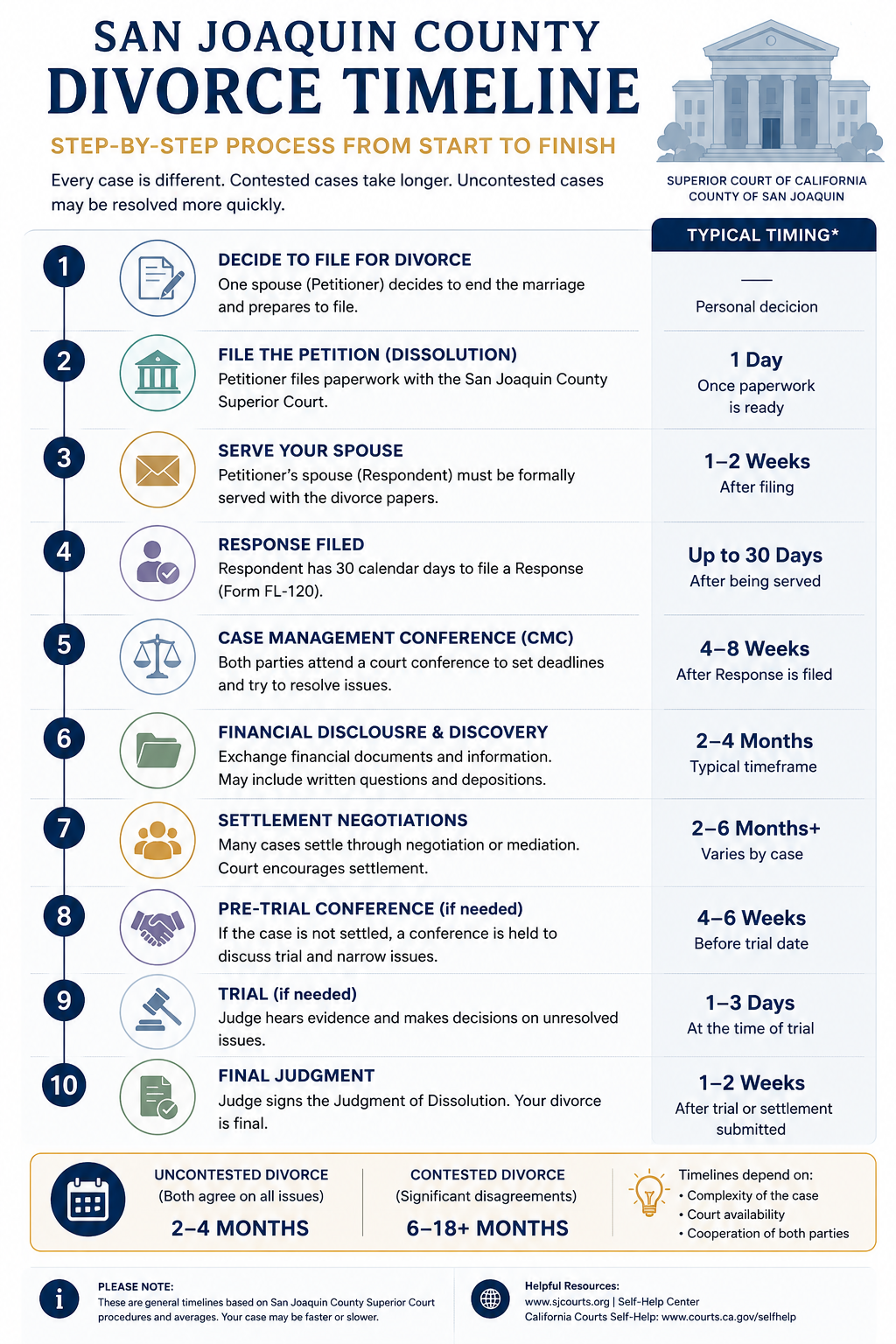
The divorce process itself begins when one spouse files a Petition for Dissolution of Marriage and formally serves it on the other spouse.
From there, the served spouse has 30 days to respond. While the case proceeds, either spouse may request temporary orders to address urgent matters such as custody, support, or use of the family home. These can be very helpful, since bills and parenting schedules do not pause for litigation that often takes months.
Both spouses are also required to fully disclose their finances, including income, assets, debts, and expenses. From there, most cases move toward negotiation, mediation, or, when an agreement cannot be reached, litigation in front of a judge.
California also imposes a mandatory six-month waiting period from the date of service before any divorce can be finalized, though the realistic divorce timeline in San Joaquin County often extends beyond these six months.
Only once every issue has been resolved, either through agreement or court order, will the judge issue a final judgment that legally ends your marriage and formalizes the terms moving forward.
Divorce in San Joaquin County
San Joaquin County divorces are filed and heard through the Superior Court of California, primarily at the Stockton Family Law Division on East Weber Avenue, with additional family law matters sometimes handled at the Lodi and Manteca branch courts.
California divorce law applies the same statewide, but the practical experience of going through a divorce here comes down to local court practice, including the pace of hearings, what to expect at each appearance, and how a given judge tends to weigh certain factors.
This is one of the most overlooked parts of preparing for divorce, and being aware of it early on can serve as a serious advantage throughout your divorce proceedings. You see, two cases with nearly identical facts can move at very different speeds depending on where they are filed and how well each spouse understands what the local court expects.
A divorce lawyer in Stockton, Lodi, or Manteca who is already familiar with these courthouses, and with the judges who preside there, tends to be more effective in moving a case forward than an attorney who has never set foot in a Stockton courtroom.
That is why, when you are ready to start looking for an attorney, it can be wise to start by searching online specifically for ‘divorce lawyer Stockton CA’ or ‘divorce lawyer San Joaquin County’.
Once that first meeting is scheduled, knowing what to bring to a divorce consultation makes that conversation far more productive. Arriving with recent pay stubs, a list of major assets and debts, and a clear sense of your priorities for custody or property allows your attorney to give you real, specific advice from the very first meeting.
Contested vs. Uncontested Divorce
Choosing between a contested divorce in California and an uncontested divorce in California is one of the first choices you will make during your divorce.
A contested divorce occurs when spouses cannot agree on one or more major issues, such as custody, property division, or support, and a judge must ultimately decide.
An uncontested divorce happens when both spouses agree on every term, which generally allows the case to move through the court system faster and at a lower cost.
Even an uncontested divorce, however, still requires accurate paperwork and a fair, legally sound agreement. Assuming a friendly divorce does not need legal guidance is one of the more common, and costly, misconceptions people often bring into this process.
It is also possible for one or both spouses to switch tracks mid-process. Tempers may flare or new information may come to light, either of which can cause a previously uncontested divorce to become contested.
Divorce Mediation vs. Litigation
Once spouses know whether their divorce is contested or uncontested, the next question is how disputed issues will ultimately be resolved. Mediation and litigation are two very different paths through a contested divorce, but both eventually result in a final, enforceable agreement.
Mediation involves working with a neutral third party to negotiate terms outside of court, while litigation places those same decisions in the hands of a judge after a divorce trial or hearing.
Mediation tends to cost less, move faster, and offer both spouses more control over the outcome, but it depends on a genuine willingness from both sides to negotiate in good faith.
That willingness can disappear quickly when one spouse is dealing with a narcissistic or controlling partner, which is why having a clear strategy for these situations matters as much as the mediation process itself.
Filing and Serving Divorce Papers
Filing for divorce in California requires more than simply dropping off paperwork at the courthouse. Filing for divorce in San Joaquin County specifically involves submitting several documents to the Superior Court, including:
- A Petition for Dissolution of Marriage (Form FL-100)
- Any required child custody declarations
- A Summons (Form FL-110)
Once filed, the other spouse must be formally notified through a process known as service. Serving divorce paperwork correctly is just as important as filing it correctly, since a case cannot move forward until service is completed and proof of that service is filed with the court.
From there, the served spouse generally has 30 days to file a response. But not everyone responds.
When a spouse ignores divorce papers entirely, the filing spouse still has legal options, including requesting a default judgment, though the path forward depends heavily on whether the paperwork was handled correctly from the very beginning.
Property and Financial Issues in Divorce
California is a community property state, which means that most assets and debts acquired during the marriage are presumed to belong equally to both spouses, regardless of whose name is on the account or the title.
Property division during a California divorce is rarely as simple as splitting everything in half, however, and disputes frequently arise over what counts as community property versus separate property that one spouse owns outright.
These disputes become more complicated, not less, the longer a marriage lasts and the more types of property are involved.
For example, a rental property and a piece of commercial real estate raise different valuation questions than a single-family home, but in every case, what you will personally keep during and after divorce depends on accurate valuation, as well as clear documentation of when and how each asset was acquired.
But this is just one example. In reality, financial issues in divorce typically extend well beyond the family home. Complex financial situations can also include:
- Multiple income streams that complicate a straightforward equal split
- Deferred compensation that has not yet fully vested
- Assets held in a trust, which are not automatically treated like other marital property
Some spouses also face financial manipulation during divorce, including hidden accounts or deliberately underreported income, which is where hidden assets and forensic accounting become essential tools for uncovering the full financial picture.
Because so much is at stake, taking the time to learn how to financially prepare for divorce early in the process, rather than reacting to financial surprises later, tends to produce far better outcomes.
High-Asset and Business Divorce
A high-asset divorce in California raises legal questions that a standard divorce case never has to address, such as:
- A business may need a professional valuation before anyone can determine what a fair division looks like
- A bonus tied to future performance is not worth the same on paper as it is once it vests
- Income drawn from investments or business interests can make the support calculation far more complicated
No matter what the details of your portfolio are, high-asset divorces in San Joaquin County and high-income divorces both require an extremely detailed look at what each spouse owns, earns, and is entitled to once the marriage ends.
Business ownership adds another layer of complexity entirely. If you or your spouse owns a business, one of the first questions to resolve is how that business should be valued, since an inaccurate valuation can cost one spouse a significant share of what they are truly owed.
Whether your business is considered shared property in the first place depends on when it was started, how it grew during the marriage, and whether separate and marital funds were ever mixed together.
Compensation structures complicate matters further. It is vital to have clarity on how RSUs and stock options, executive compensation packages, or holdings in private equity and investment accounts get divided, since these assets often vest over time and are harder to value than a simple paycheck.
The same is true of luxury assets and hidden wealth, and increasingly, cryptocurrency and other digital assets, both of which require deliberate effort to locate, value, and divide fairly, rather than simply taking one spouse’s word for what exists.
Child Custody and Child Support During Divorce
For parents, child custody and child support are often the most emotionally significant issues in the entire divorce. California courts decide on both of these matters based on the best interests of the child, rather than what either parent personally wants.
Custody includes both where the child will primarily live, known as physical custody, and who holds the legal authority to make decisions about their education, healthcare, and upbringing, known as legal custody.
It is no secret that custody cases can be emotional, stressful, and intense. Contentious custody disputes often arise from:
- Relocation
- Allegations that one parent is unfit
- Disagreements over parenting time
- Move-away cases where one parent wants to relocate with the child
These situations tend to raise some of the most difficult legal questions in family law.
Custody arrangements also directly affect child support in split custody situations, since the financial responsibility shifts depending on how parenting time is divided.
Child support itself follows a statewide guideline formula based on income and parenting time, but that formula gets more complicated for higher earners and business owners alike.
How San Joaquin County courts calculate child support for high-income earners and how child support works when a parent owns a business both depend on accurately identifying true income, which is rarely as straightforward as reviewing past pay stubs.
Spousal Support During Divorce
Spousal support, often called alimony, is never automatic in a California divorce. Unlike child support, there is no fixed formula for long-term spousal support, which means the outcome depends heavily on the specific facts of the marriage.
Speaking with a spousal support attorney early in the process is one of the clearest ways to understand what you may be entitled to receive, or expected to pay.
Spousal support in San Joaquin County and alimony in San Joaquin County both depend on factors such as the length of the marriage, each spouse’s earning capacity, and the standard of living established during the marriage.
These cases grow more complex at the upper end of the income scale, where alimony for the higher-income spouse often becomes a point of significant contention. In these situations, it can be helpful to work with a forensic accountant, whose role is to define true income and uncover hidden assets.
Divorce Settlements and Final Judgments
Most California divorces end through a negotiated agreement rather than a trial, which gets formalized into a Marital Settlement Agreement outlining every term, from property division to custody and support.
Divorce settlements in San Joaquin County generally move faster and cost less than arguing your case in court, but only when both spouses truly comprehend and agree to every outlined term before signing.
That said, adopting a mindset of “getting through it as quickly as possible” tends to do more harm than good.
You see, rushing a settlement to end the emotional toll of divorce sooner often leads to regret months or years later, particularly if you later realize you agreed to terms you did not fully understand. This is one of several common mistakes people make during a divorce in California.
Once a settlement or judgment is finalized, it carries serious legal weight. If one spouse fails to comply—even if they now feel the arrangement is unfair—then the options are to get help with enforcing that judgment or file a formal motion with the court to modify it.
Special Divorce Situations
Just like no two marriages are alike, no two divorces are exactly alike either. Several situations call for additional legal considerations beyond common issues already covered, including:
- Disputes over who keeps a beloved family pet
- Cultural property disputes, such as the division of gold jewelry in Indian divorces
- Same-sex divorce, particularly for couples whose relationships predate full marriage equality
- LGBTQ divorce in Stockton, which raises specific local considerations around parentage and recognition
- The unique complications same-sex couples can face around property acquired before marriage was legally recognized
- Gray divorce, the growing trend of couples divorcing later in life, is often centered on retirement accounts rather than custody
Each of these will require an attorney who understands both the legal process and the personal or cultural significance involved in order to achieve a favorable outcome.
Talk to a San Joaquin County Divorce Lawyer Today
Divorce changes nearly every part of your life all at once, and as you try to restabilize, you are also navigating a complex, high-pressure legal process.
Each decision you make along the way, involving property, custody, support, or timing, deserves the same level of care you would give any decision that impacts the next chapter of your life.
At Bansmer Law, Erica M. Bansmer has spent more than a decade as a California divorce attorney helping individuals throughout San Joaquin County navigate divorce with clarity and strategic representation, whether your case settles quickly or requires a longer back-and-forth process.
If you are facing divorce and want to understand exactly what steps are worth taking next, contact Bansmer Law today at (209) 474-2400 to schedule a consultation.
Frequently Asked Questions About Divorce in California
How long does divorce take in California?
A California divorce takes a minimum of six months and one day from the date the other spouse is formally served with divorce papers, regardless of how quickly both spouses agree on the terms. This waiting period is required by law and cannot be shortened, even in a fully uncontested case.
Contested divorces involving custody disputes, complex assets, or an uncooperative spouse often take significantly longer, sometimes a year or more, depending on court schedules and how quickly both sides reach an agreement.
What are the legal requirements for divorce in California?
To file for divorce in California, at least one spouse must meet the state’s residency requirements. Specifically, this generally means:
- Living in California for the past six months
- Living in the county of filing for the past three months
California is also a no-fault state, so neither spouse needs to prove wrongdoing. Beyond residency, spouses must properly file and serve the correct court forms before a case can move forward.
Do both spouses have to agree to get divorced?
No, only one spouse needs to want the divorce for the court to grant it. California is a no-fault state, meaning the filing spouse only needs to cite irreconcilable differences rather than prove any wrongdoing.
The other spouse cannot block the divorce simply by refusing to participate or disagreeing with the decision. Refusing to respond, however, can still result in a default judgment being entered against that spouse.
What happens if my spouse ignores the divorce papers?
If your spouse does not respond within 30 days of being served, you may request that the court enter a default judgment using Form FL-165. This generally means the case proceeds based on the terms you requested, since your spouse forfeited the chance to contest them.
Before requesting a default, you must prove that service was completed correctly, which is why accurate proof of service matters so much earlier in the process.
Can I keep the house after divorce?
Keeping the house after divorce is possible, but it generally depends on whether it is community or separate property, and whether you can afford to buy out your spouse’s share. Under California’s community property laws, a home purchased during the marriage is typically owned equally by both spouses.
Common solutions include refinancing the mortgage into one spouse’s name, offsetting the home’s value with other assets, or selling the home and splitting the proceeds.
How is property divided in California?
California divides marital property under community property law, which presumes that most assets and debts acquired during the marriage belong equally to both spouses. This generally includes:
- Income earned during the marriage
- Real estate purchased during the marriage
- Retirement growth and business growth during the marriage
Property owned before the marriage, along with gifts or inheritances received individually, is typically considered separate and is not divided.
How does custody work during divorce?
California courts decide custody based on the best interests of the child rather than either parent’s personal preference. Custody includes two separate components: physical custody, meaning where the child primarily lives, and legal custody, meaning who makes decisions about education, healthcare, and general upbringing.
Courts can award sole or joint custody for either type, and arrangements can later be modified if circumstances meaningfully change.
How is child support calculated during divorce?
California uses a statewide guideline formula to calculate child support, based primarily on both parents’ incomes and the amount of time each parent spends with the child. You can estimate your own obligation using the state’s official child support calculator.
Courts can deviate from the guideline amount in certain circumstances, such as extraordinarily high income, special medical needs, or shared custody arrangements that do not fit the standard formula.
Will I have to pay spousal support?
Spousal support is not guaranteed in any California divorce, and whether you will pay or receive it depends on the specific facts of your marriage. Judges weigh several factors under California Family Code Section 4320, including:
- The length of the marriage
- Each spouse’s earning capacity
- The standard of living during the marriage
There is no fixed formula for long-term support, which makes skilled legal representation especially valuable in these cases.
When should I hire a divorce lawyer?
The earlier you involve a divorce lawyer, ideally before you file or respond to a petition, the more protected your rights and finances tend to be throughout the process.
Even in an amicable, uncontested divorce, San Joaquin County’s family law self-help resources can only offer general procedural guidance, not legal advice tailored to your situation. Waiting until a dispute escalates often limits your options rather than expanding them.