 CALL US NOW
 EMAIL US NOW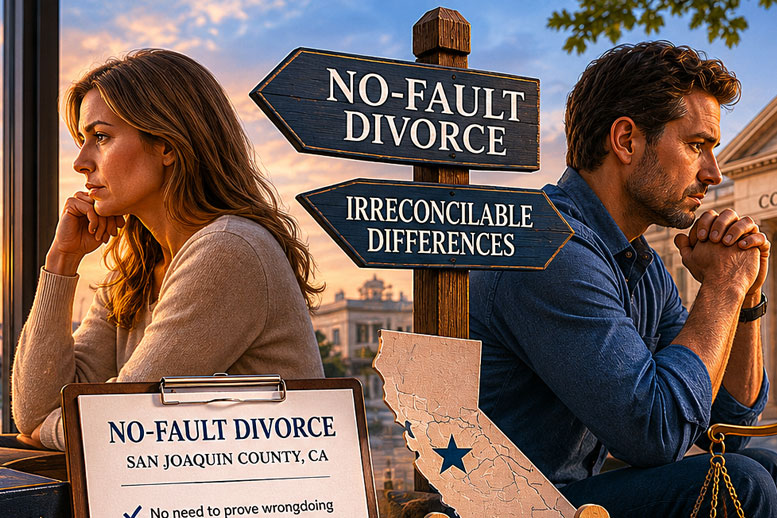
When a marriage ends, it rarely ends cleanly. There are quite a few breaches of trust that are all too common, like one spouse hiding money, being unfaithful, or building up debt and lying about it. Many people arrive at filing for divorce after enduring years of being seriously wronged time and time again.
So when you hear that California is a “no-fault divorce state,” it is absolutely natural to wonder what that means for your case. Does the court simply ignore what happened? Does your spouse face no consequences? Is what you experienced during this marriage just legally irrelevant?
The answer is more nuanced than a simple yes or no—and understanding that nuance is one of the best ways to protect your best interests during this process.
You see, no-fault divorce means you do not need to prove wrongdoing before you can file. At the same time, past wrongdoing or misconduct can have a major impact on your eventual divorce settlement.
California is Legally a No-Fault Divorce State
In 1969, California became the first state in the country to eliminate fault as a requirement for divorce, through the California Family Law Act. Every other state has since adopted some version of no-fault divorce.
Under California Family Code § 2310, there are only two recognized legal grounds for divorce in California: irreconcilable differences and permanent legal incapacity. In practice, nearly every divorce filed in San Joaquin County proceeds on the first ground.
“Irreconcilable differences” does not require a dramatic explanation or a specific incident. It simply means the marriage has broken down in a way that cannot be repaired.
You do not need to specify what caused it, describe any particular event, or convince the court that your reasons meet some threshold of seriousness. The fact that the marriage cannot continue is sufficient.
The second ground, which is permanent legal incapacity, refers to a spouse who lacks the capacity to make decisions. It is rare in practice, and it requires medical or psychiatric testimony to establish.
To learn more, read our full overview of what California law requires to file for divorce, including residency requirements and necessary documentation.
What No-Fault Divorce Means for Your Case
To be clear, it is not possible to get a fault divorce in San Joaquin County, nor any county in California. While in some states, it is worth considering the benefits of filing for no-fault versus fault divorce, this is not an option here.
Beyond that, no-fault divorce has three practical implications that are important to understand before your case proceeds.
First, you do not need your spouse’s agreement or cooperation to file. One spouse’s decision to end the marriage is legally sufficient. The court does not require mutual consent.
Second, you do not need to prove your spouse did anything wrong. The court is not in the business of determining who caused the marriage to fail. Fault, in the traditional legal sense, plays no role in whether a divorce is granted.
Third, your spouse cannot prevent the divorce from happening. California law does not give the opposing party a mechanism to block the proceedings simply by objecting.
Where Marital Misconduct Still Has Legal Consequences in San Joaquin County
No-fault divorce removes fault as a condition for filing. But it does not remove the consequences of certain behavior from the broader proceedings.
In several key areas, what happened during your marriage—and how each party has conducted themselves since—remains directly relevant under California law.
Domestic Violence and Spousal Support
A documented history of domestic violence can affect spousal support determinations in San Joaquin County. California law directs judges to consider domestic violence when evaluating whether to award support to the spouse who committed it.
For victims, a documented history of abuse may support a stronger case for receiving support.
In these situations, the court is still not assigning blame for the breakdown of the marriage. It is instead recognizing that certain conduct carries legal consequences in specific areas of the proceedings, including spousal support.
If domestic violence is part of your situation, working with an attorney who understands how to document and present that history is essential.
Hidden Assets and the Duty of Full Disclosure
Both spouses in a California divorce are legally required to provide complete financial disclosure. This is not optional, no matter what the details of your case may be.
A spouse who conceals income, transfers assets, or fails to disclose accounts is in breach of their fiduciary duty—and San Joaquin County courts take this seriously. Sanctions, adjusted property awards, and adverse credibility findings are all possible outcomes when concealment is uncovered.
A strategic divorce attorney will also leverage legal tools to pursue undisclosed financial information, including subpoenas and forensic accounting analysis.
Child Custody and the Best Interests Standard
Custody in California is governed by the best interests of the child, not by fault. That said, how judges choose to honor this specific standard is heavily influenced by each spouse’s past behavior.
A parent’s history of substance use, documented neglect, or exposure of a child to harmful situations are all factors a San Joaquin County judge may weigh in determining custody and visitation arrangements. These considerations are not about penalizing a parent for causing the divorce, but rather are meant to protect the child going forward.
For a closer look at how property division, support, and settlement terms come together in a San Joaquin County case, see our guide to divorce settlements in San Joaquin County.
How the No-Fault Divorce Process Works in San Joaquin County
Filing for divorce in San Joaquin County begins with submitting the Petition for Dissolution of Marriage (Form FL-100) to the San Joaquin County Superior Court. The petition does not require a detailed explanation of your reasons; citing irreconcilable differences is sufficient.
Once the petition is filed, your spouse must be formally served with the documents. The mandatory six-month waiting period under California law begins on the date of service, not the date of filing. No divorce in California can be finalized before six months and one day from service, regardless of how uncomplicated the case may be.
During that period, temporary court orders for spousal support, child custody, and property use can be put in place while the final terms are negotiated or litigated.
For a detailed walkthrough of what to expect at each stage, see our guides to filing for divorce in San Joaquin County and the divorce process in San Joaquin County.
The Details of Your Marriage Still Matter
No-fault divorce refers only to the initial reason for filing. It absolutely does not absolve both parties of responsibility.
How your assets are divided, whether spousal support is awarded and for how long, how custody is structured—all of these depend on the specific facts of your situation.
Said another way, it is true that the court does not assign blame for the breakdown of the marriage. But it is also true that the behavior that occurred during your marriage, the financial picture that emerges through disclosure, and the circumstances surrounding your children can have a major impact on everything from alimony to child custody.
At Bansmer Law, Attorney Erica M. Bansmer has over a decade of experience helping individuals throughout San Joaquin County navigate divorce and the many complexities of the legal process.
To understand exactly how your circumstances affect your case, contact our office at (209) 474-2400 to schedule your consultation.
Frequently Asked Questions About No-Fault Divorce in San Joaquin County, CA
What is no-fault divorce in San Joaquin County?
No-fault divorce is a divorce in which neither spouse is required to prove the other did anything wrong. In San Joaquin County, as throughout California, the only recognized grounds for divorce are irreconcilable differences and permanent legal incapacity.
Nearly all divorces proceed on the basis of irreconcilable differences, which simply means the marriage has broken down and cannot be repaired. Fault (in the traditional legal sense) plays no role in whether the divorce is granted.
Do you have to prove anything in a no-fault divorce?
To obtain the divorce itself, no, California courts do not require proof of wrongdoing. However, the proceedings that follow may involve matters where documentation and evidence are essential.
A history of domestic violence can affect spousal support. Hidden assets can result in sanctions and adjusted property awards. “No-fault” refers to the grounds for filing, not to the standards that govern every aspect of what follows.
Can a divorce be denied in California?
In most circumstances, no. Because California is a no-fault state, a spouse who wants to end the marriage cannot be stopped by the other party’s objection. The court does not require mutual consent.
However, a judge may decline to finalize a divorce if required legal steps remain incomplete, such as financial disclosures, proper service of process, or resolution of outstanding issues. Meeting all procedural requirements is essential to moving the case forward.
Which court handles divorces in San Joaquin County?
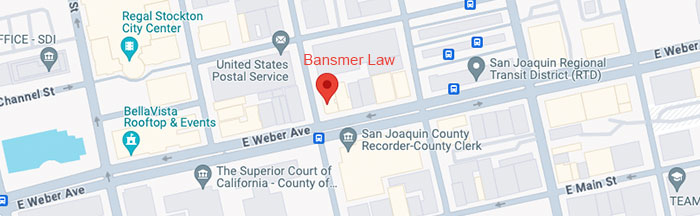
Divorce and family law matters in San Joaquin County are handled by the San Joaquin County Superior Court, primarily through the Family Law Division located at 180 East Weber Avenue in Stockton. Depending on the details of a case, the Manteca Branch Court may also hear certain family law matters.
Can I divorce without my spouse agreeing?
Yes. Under California’s no-fault divorce law, one spouse’s decision to end the marriage is sufficient. A spouse’s refusal to participate, sign documents, or engage with the process does not prevent the divorce from proceeding.
If your spouse fails to respond after being properly served, the court may issue a default judgment. An experienced San Joaquin County divorce attorney can help you navigate that outcome and protect your interests throughout the process.