 CALL US NOW
 EMAIL US NOW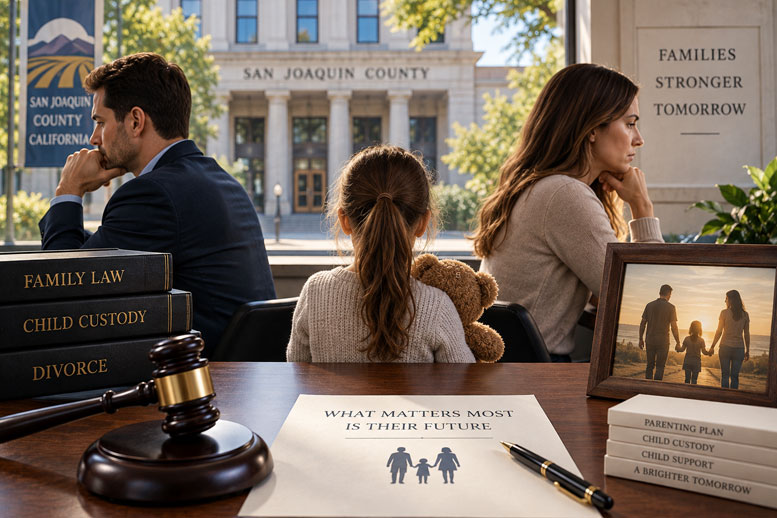
If you’re facing a divorce and have children in San Joaquin County, it’s natural to feel overwhelmed by the legal and emotional challenges ahead. The court’s top priority is ensuring your children’s well-being, which means custody, support, and parenting arrangements are closely examined before the divorce can be finalized. In San Joaquin County, the process involves filing specific documents, meeting residency requirements, and navigating custody decisions based on what is deemed in the child’s best interests.
Legal custody, physical custody, child support, and visitation schedules must be addressed through detailed parenting plans that courts will review and approve. The court relies heavily on documented evidence about each parent’s role, child safety concerns, and any history of domestic violence. Child support calculations follow a state formula, heavily influenced by parenting time. You can expect to engage in mediation or court hearings designed to build an arrangement that serves your children’s needs.
Understanding the process and preparing accordingly can help you protect your parental rights and your child’s stability. While this may seem complex, taking the right steps early makes a pivotal difference in your experience and your children’s future during and after divorce.
For parents navigating divorce, the experience is so much more than a complex legal process. Yes, you are dealing with court dates and paperwork deadlines, but you are also required to do some more emotional work, too.
You must determine how to speak to your children about what is happening, how to manage the logistics of two households, and how to make decisions about their future alongside someone you are simultaneously separating from.
Most importantly, in San Joaquin County, the courts will not finalize a marriage dissolution until custody, support, and a parenting plan are resolved. That is why it is so important to approach these issues with a clear, effective strategy.
Read on to learn more about the unique factors to be aware of during a divorce involving children in San Joaquin County, CA.
The Legal Framework for Divorce Involving Children in San Joaquin County, CA
The first legal requirement to be aware of when filing for divorce in San Joaquin County is that at least one parent must have lived in California for six months and in San Joaquin County for three months.
For families with existing agreements, it is also key to understand how a prenuptial agreement affects the terms of a California divorce, as these can have direct implications for property division when children are part of the picture.
Beyond that, before finalizing any divorce, the court addresses legal custody, physical custody and the parenting plan, child support, and property division. We will take a closer look at these factors now.
How Child Custody Is Determined in San Joaquin County Divorces
California recognizes two categories of custody, and each can be awarded jointly or solely to one parent. First, legal custody governs decision-making authority over education, healthcare, and religious upbringing. Second, physical custody determines where the child lives and the daily care arrangements between parents.
All custody decisions are governed by the best interests standard under California Family Code Section 3011, which directs judges to weigh each parent’s history of care, the child’s health and safety, any documented domestic violence, and the strength of the child’s existing bonds with each parent.
In San Joaquin County, that standard is applied to documented evidence, and your assertions alone are not considered evidence. Working with an experienced divorce attorney is the best way to understand what does count and how to gather that evidence.
Visitation Rights and Parenting Plans After Divorce
A parenting plan is legally required in every California divorce involving minor children. The plan must specify the regular timesharing schedule, holiday and vacation arrangements, transportation and exchange logistics, and a process for resolving future disputes.
San Joaquin County courts will not approve vague plans.
Language such as “the parents will share time equitably” is not enforceable—it virtually always results in disagreements that force both parents to attend additional court hearings. That is why specificity is so critical during this stage.
Child Support Obligations and Enforcement
California calculates child support using a statewide guideline formula under Family Code Section 4055, based primarily on each parent’s net monthly income and the percentage of parenting time each has with the children.
Courts apply this formula in every case, and departing from the amount it produces requires a specific legal basis that a judge must approve.
Beyond the base support, courts require parents to share childcare costs tied to employment, uninsured medical expenses, and educational costs for children with special needs.
To be clear, the parenting schedule is itself a primary input in the formula. The more time a child spends with one parent, the lower that parent’s support obligation tends to be.
The Divorce Filing Process Itself
Filing requires three primary documents, each of which carries a filing fee:
- The Petition for Dissolution (FL-100)
- The UCCJEA Declaration (FL-105)
- The Summons (FL-110)
Once served, the responding parent has 30 days to file a response. When children are involved, either party may request temporary custody and support orders while proceedings continue to unfold.
Your divorce cannot be finalized until every detail, including custody arrangements, has been addressed.
Special Considerations (Domestic Violence, Child Safety, and Custody Modifications)
California Family Code Section 3044 establishes that when a parent has a documented history of domestic violence within the previous five years, the court begins with the position that this parent should not receive custody—whether legal, physical, or both.
That position can be challenged, but doing so requires completing a 52-week batterer intervention program and demonstrating compliance with all protective orders. If domestic violence is a factor in your case, retaining counsel immediately is the most impactful step you can take right now.
Custody orders are also modifiable after judgment. When there is a material change in circumstances, such as a parent’s relocation, a shift in the child’s safety or needs, or a significant income change, either party may file a Request for Order to seek modification.
Common Mistakes Parents Make During Divorce with Children in San Joaquin County, CA
As a parent navigating divorce, there are more pitfalls to be aware of throughout the course of your case. Avoiding these three common mistakes can not only make the proceedings go a little more smoothly, but also lead to a better overall outcome in your case.
The first is involving children in adult conflict, which includes disparaging the other parent, using them as messengers, or discussing court proceedings with them.
San Joaquin County judges treat this as evidence that a parent is unwilling to support the child’s relationship with the other parent. This can ultimately become a point against you during custody discussions.
The second is leaving the family home before a temporary custody order is established.
Moving out without an order creates a status quo that courts are reluctant to disturb. If safety requires leaving immediately, a request for emergency temporary orders should be filed that same day rather than you leaving on your own.
The third is negotiating custody and child support in isolation.
You see, the parenting schedule you and your ex agree to is what directly determines who pays child support, and how much. So, discussing and resolving them together produces fairer divorce settlements in San Joaquin County and fewer return trips to argue in court.
Protecting Your Children Starts with the Right Legal Strategy
Divorce involving children means a complete restructuring of your family’s daily life, but the details are not entirely up to you. Instead, the outcome is governed by legal standards that require representation from an attorney with more than just general knowledge of California law.
Attorney Erica M. Bansmer has spent over a decade representing parents in custody, support, and parenting plan matters throughout Stockton, Tracy, and San Joaquin County. Call (209) 474-2400 to schedule your consultation today.
FAQs About Divorce When You Have Children in San Joaquin County, CA
What are the first steps I should take if I want to file for divorce with children in San Joaquin County, CA?
Confirm residency requirements first, as at least one parent must have lived in California for six months and in San Joaquin County for three months. Required documents you must file include FL-100 (Petition for Dissolution), FL-110 (Summons), and FL-105 (UCCJEA Declaration), which is specific to cases involving minor children.
California’s required divorce forms are available through the state self-help portal. If you are still determining which dissolution route applies to your relationship, clarify whether divorce or annulment is the right path before you file.
How is child custody decided in San Joaquin County divorces?
Custody in San Joaquin County is determined using the best interests standard under California Family Code Section 3011. Judges weigh each parent’s history of care, the child’s health and safety, any documented domestic violence, and the child’s existing bonds with each parent.
Furthermore, legal custody (decision-making authority) and physical custody (where the child lives) are evaluated separately, and each can be awarded jointly or solely to one parent. Outcomes are determined by documented evidence, not by parental assertions.
How does mediation work for child custody disputes in San Joaquin County?
San Joaquin County requires parents in contested custody disputes to attend Family Court Services mediation before a judge hears your case. The mediator works with both parents to develop a parenting plan; if no agreement is reached, the mediator’s written recommendation is submitted to the court, and the case proceeds to a hearing.
Be aware that recommendation carries significant weight. Parents who arrive with a clear proposal and supporting documentation are consistently better positioned. Our complete San Joaquin County divorce guide covers what to expect at each stage.
How does domestic violence affect custody in San Joaquin County?
Under California Family Code Section 3044, when a parent has a documented domestic violence history within the previous five years, the court automatically takes the stance that awarding that parent custody—whether legal or physical—is not in the child’s best interests.
You do have the option to fight back against this, but doing so requires completing a 52-week batterer intervention program and complying with all protective orders. Retaining an attorney immediately, and understanding your options for limiting contact with a co-parent, are both essential early steps.
How can I modify custody orders after a San Joaquin County divorce?
Custody and child support orders are modifiable when there is a material change in circumstances. Common qualifying changes include:
- A parent’s relocation
- Violations of the existing custody order
- A substantial income change affecting support
- A documented shift in the child’s safety or needs
Modifications are not retroactive. They apply from the date the Request for Order is filed, not from when the circumstances changed. Contact Bansmer Law to discuss whether your situation qualifies.
Related Resources
- For more comprehensive information on family law matters in San Joaquin County, explore our main Divorce and Family Law Practice Area page. It offers detailed guidance on all aspects of family law, including custody, support, and marital dissolution.
- To deepen your understanding of child custody issues, visit our post on Child Custody and Visitation in San Joaquin County, which explains custody types, parental rights, and tips for effective co-parenting.
- For insights on financial aspects, check out our article on Child Support in California: How It’s Calculated and Enforced, covering the state guidelines, income considerations, and enforcement actions specific to San Joaquin County.
- If you are facing complications involving domestic violence or safety concerns during divorce, our resource titled Domestic Violence and Custody: Protecting Children in San Joaquin County provides critical information on legal protections and court procedures.
- Together, these linked resources will help you navigate the complex landscape of divorce when children are involved in San Joaquin County, offering practical advice and legal clarity beyond the initial steps.