 CALL US NOW
 EMAIL US NOW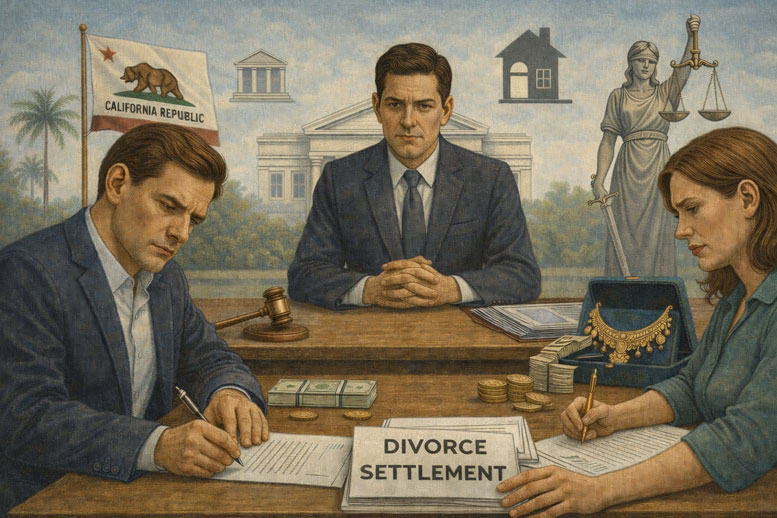
When a California divorce begins, the word “settlement” starts appearing quickly— in attorney consultations, in paperwork, and in advice from friends who have been through it themselves. And yet, most people navigating divorce do not know how this paperwork fits into the overall process.
A divorce settlement in San Joaquin County is a formal legal document called the Marital Settlement Agreement (MSA). It resolves every outstanding issue in your divorce (property, support, debt, and custody), and once the San Joaquin County Superior Court approves it, it carries the same legal force as a court order.
What it says, and what it fails to say, can shape your financial future and your children’s lives for years to come. Understanding what a settlement covers, and how it is reached, is the first step toward protecting what matters most.
What is a Divorce Settlement in California?
Not every California divorce ends in settlement, which is the first thing to know. When spouses cannot agree on one or more issues, a judge at the San Joaquin County Superior Court makes the final determination.
A settlement is what happens instead of that: both parties negotiate and reach their own agreement on every outstanding issue, rather than leaving those decisions to the court.
That agreement takes the form of a document called the Marital Settlement Agreement (MSA)— a written, signed contract that, once approved by the court, carries the same legal force as a court order.
Settlement is generally faster, less costly, and gives both parties far more control over the outcome than litigation does.
But the terms must be complete, legally sound, and carefully drafted, because what the MSA does and does not include can govern your finances, your property, and your interactions with your children for years to come.
What a Divorce Settlement in San Joaquin County Must Address
California is a community property state. Under California Family Code §2550, assets and debts acquired during the marriage are generally presumed to belong equally to both spouses. Your MSA must resolve what happens to all of it.
Division of Community Property
Generally, community property is anything earned or acquired during the marriage. Separate property includes assets owned before the marriage or received as gifts or inheritance.
Once you have established which assets are community property, the MSA must establish how community assets and debts will be divided. Contested valuations, commingled funds, and undisclosed accounts are among the most common sources of dispute at this stage.
The Family Home
The family home is often the most emotionally charged decision in any San Joaquin County divorce settlement. The options are to sell the home and divide the proceeds, have one spouse buy out the other’s share, or, in cases involving minor children, defer the sale to a later date.
Each path carries financial and tax consequences that deserve careful consideration before you sign anything.
Retirement Accounts and QDROs
If either spouse holds a 401(k), pension, or similar plan that grew during the marriage, dividing it correctly requires a specific court order called a Qualified Domestic Relations Order (QDRO).
Without a properly drafted QDRO, attempting to divide a retirement account can trigger significant tax penalties. A rushed or incomplete divorce settlement can cause this outcome, even when neither party intends it.
Spousal Support
Spousal support is governed by California Family Code §4320, which outlines the factors a court weighs when determining the amount and duration. But be aware, there is no fixed formula for long-term support.
Length of the marriage, each spouse’s earning capacity, the marital standard of living, and other factors all play a role in the calculation. A well-drafted MSA addresses both whether support will be paid, and the specific circumstances under which it may later be modified.
Child Custody and the Parenting Plan
When children are involved, the MSA must include a parenting plan that distinguishes between legal custody (decision-making authority over education, healthcare, and general welfare) and physical custody (determines where the child primarily resides).
California courts evaluate these arrangements under the best interest of the child standard, as defined in California Family Code §3011.
Child Support
Child support in California is calculated using a statewide guideline formula, driven primarily by each parent’s income and the proportion of time the child spends with each parent. Deviations from the guideline amount are permitted in limited circumstances but must be justified to the court.
How a Divorce Settlement is Reached
Most divorce cases in San Joaquin County are resolved through negotiation or mediation rather than trial. The process begins with mandatory financial disclosure— both spouses are legally required to fully and accurately disclose all assets, debts, income, and expenses.
From there, the parties negotiate the terms, typically with attorneys facilitating the discussions.
If agreement cannot be reached, the case proceeds to the San Joaquin County Superior Court Family Law Division in Stockton, where a judge makes the final determination on any unresolved issues. The Manteca Branch handles certain matters as well, depending on case volume.
But there is one additional constraint that applies to every case, regardless of how quickly both parties reach an agreement. California law requires a minimum waiting period of six months and one day from the date the respondent is served with the divorce petition before the dissolution can be finalized.
Why the Drafting and Review Phase Matters
A signed MSA does not become a court order until it is submitted to and approved by the court, typically through the Judgment (Form FL-180). Until that step is complete, it is a contract that cannot be enforced the same way a court order can.
This is also why what gets written into the agreement matters as much as the negotiation itself.
Vague language, overlooked assets, undisclosed accounts, or terms that seem workable today but invite dispute later can all undermine a settlement that both parties believed was fair.
Rushing the process before financial disclosure is complete is one of the most consequential mistakes made in San Joaquin County divorce cases— and one of the most common.
How Bansmer Law Approaches Divorce Settlements
At Bansmer Law, Attorney Erica M. Bansmer has spent over a decade helping clients in Stockton, Tracy, and throughout San Joaquin County negotiate and finalize divorce settlements that protect what they care about most.
Her approach is direct and strategic. She works to ensure that every term of your MSA reflects your actual circumstances, that nothing of consequence is left unaddressed, and that the agreement you sign will remain on solid legal ground long after the process is over.
To schedule a consultation, contact Bansmer Law at (209) 474-2400.
Frequently Asked Questions
Do I need a court appearance for a divorce settlement in San Joaquin County?
Not always. If both spouses reach a full agreement through negotiation or mediation, the MSA can be submitted to the San Joaquin County Superior Court for approval without a formal hearing. However, if any issues remain unresolved, a court appearance before a judge is required. The complexity of your case will largely determine whether you set foot in a courtroom.
How do I draft a divorce settlement agreement in California?
A California MSA must address, at a minimum:
- Spousal support terms, if applicable
- Division of all community property and debts
- A parenting plan covering legal and physical custody
- A child support calculation consistent with California’s guideline formula
Both parties must sign the completed agreement. It then must be submitted to the court for approval and incorporated into the final judgment. Given the legal and financial consequences involved, working with a qualified attorney throughout the drafting process is strongly advised.
Do both spouses have to agree to a settlement?
No. While a settlement requires mutual agreement, this is not the only path to finalizing a divorce. California is a no-fault state, meaning one spouse can move forward with the dissolution regardless of whether the other consents to a settlement.
When you cannot reach an agreement on one or more issues, those matters are decided by a judge at the San Joaquin County Superior Court Family Law Division in Stockton. Settlement is often the ideal option, but it is never a requirement.
Can a divorce settlement be changed after it is finalized?
Some terms can be modified; others generally cannot. Under California Family Code §3651, child support and spousal support orders may be modified if there has been a material change in circumstances, such as a significant income change, remarriage, or retirement.
Property division, once approved by the court, is typically final. Any request for modification requires a return to court with supporting evidence of the changed circumstances.
Do I need a divorce lawyer in San Joaquin County?
California law does not require it, but the stakes make legal representation worth serious consideration. A divorce settlement governs property rights, financial support, and, when children are involved, parenting arrangements that affect daily life for years. Errors in drafting, missed disclosures, or poorly negotiated terms can be difficult or impossible to undo after the court approves the agreement.
An experienced San Joaquin County divorce attorney protects your interests at every stage of the process.